Strength and Beauty: Perugia’s Etruscan Arch
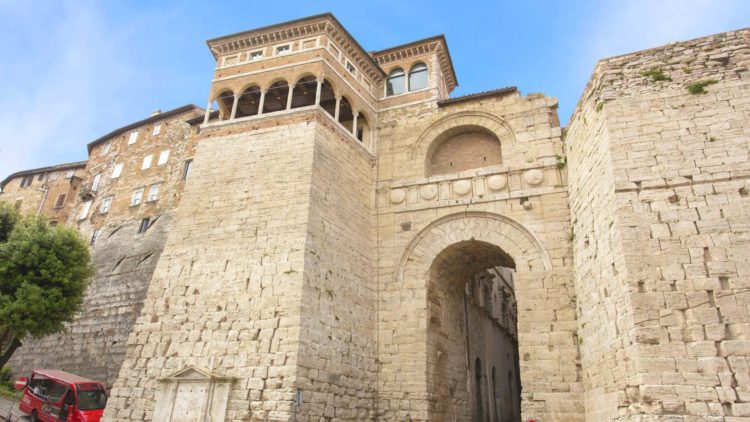
To put it mildly, Perugia’s Etruscan Arch (L’Arco Etrusco di Perugia) is a remarkable sight. Built by the Etruscans in the third century B.C., this impressive feat of architectural ingenuity remains largely intact and still stands strong after more than two thousand years. According to one Italian guidebook, were it not for the Fontana Maggiore, the Arco Etrusco would be considered the monument most representative of Perugia. Its ancient dignity is a motionless witness to the history of ages.
Also known as the Arch of Augustus, this totally badass piece of history, constructed from mighty blocks of chiseled stone is one of the original gates of Perugia. Like the other city entrances, it was retrofitted into the equally massive Etruscan walls, which fortified the city in the fourth century B.C. If this gate were worthy of a slogan to capture its imposing stature, “Built to Last” would certainly apply.
Standing at the city’s northern side at the bottom of Via Ulisse Rocchi, it towers over Piazza Grimana and Palazzo Gallenga-Stuart, which houses the University for Foreigners. Its design consists of a vaulted archway crowned by a decorative frieze and flanked by two imposing towers that taper upwards to 20 meters. As if that weren’t enough of a statement, a smaller arch at the top is nestled between a set of pilasters. In keeping with the layer cake of architectural styles that endow Perugia with its enchanting appeal, a Renaissance loggia is perched on top and a 17th-century fountain sits at its base.
This structure, built with such astonishing precision by these ancient people, is pretty hard to ignore on one’s daily commute. The words “Augusta Perusia” inscribed across the lower arch remind us that the Etruscans, whose origins and language remain a mystery to this day, fell to the Romans in 40BC. Along the bottom edge of the frieze another inscription “Colonia Vibia” records Perugia’s former time as a colony, a status granted by Vibio Treboniano Gallo, a Roman emperor with hometown roots.
Thanks in part to the charitable donations of Brunello Cucinelli, the renowned fashion designer of humble Umbrian origins, the Arco Etrusco was restored about a decade ago. With centuries of grimy build-up removed, it’s now been returned to its original ivory hue—reminding us that strength and beauty can in fact go hand in hand.
Read our blog posts
-
Shopping in Perugia: Materia Ceramica
If you are shopping in Perugia, you’ll find a world of small shops and local restaurants on Via dei Priori…
-
8 reasons to visit the National Gallery of Umbria
The National Gallery of Umbria is one of Perugia’s most important museums. It’s also the only major art collection in…
-
Giuditta Brozzetti Museum-Lab: Weaving Perugia’s Past & Present
Perugia’s Museum Workshop Giuditta Brozzetti (Il Museo-Laboratorio Giuditta Brozzetti) is about a 15-minute walk from Piazza IV Novembre. This hidden…